
Teatro Meron’s Ang Medea: A Faithful Yet Remarkable Filipino Retelling
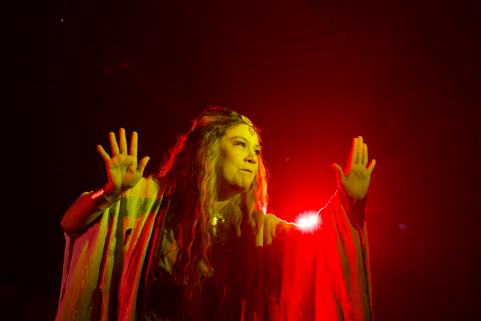
The feeling of betrayal is universal, shared among all of humanity through a variety of equally heartbreaking experiences. And as much as we’d like to let all our emotions out in a fit of sadness or rage, our ethical boundaries—our conscience—tells us otherwise. Sure, ethically, it’s better to keep one’s peace rather than ruin another’s, but what if one throws out their conscience? What if one defies their ethical boundaries to satisfy their relentless need for revenge? Teatro Meron presents Ang Medea, National Artist Rolando Tinio’s Filipino adaptation of Euripides’ classic Greek tragedy, Medea.
Ang Medea follows Medea, a woman who gave up her homeland for her husband, Yason (Jason in the original text), only to realize she’d been betrayed and banished to a land that never accepted her. At its core, the story captures Medea’s raw catharsis—her consuming fury, grief, and desire for brutal resolution—that pushes her beyond her ethical boundaries. Ultimately, the play pits these perspectives against each other, reminding its audience that fighting for respect, honor, or justice is shared by all of humanity, while acknowledging the fine line between the actions of a human and of a monster.
The production features Katski Flores as Yaya, Teroy Guzman as Creon, Gold Soon and Pickles Leonidas as Koro, Joseph Dela Cruz as Ogeo, Joel Macaventa as Maestro, Brian Sy and Yan Yuzon as Yason, and Miren Alvarez-Fabregas as Medea.
Behind the curtains, the production is under the direction of Teatro Meron founder Ron Capinding, with Tata Tuivera as set designer, Ian Bautista as lighting designer, Zak Capinding as sound designer, Gabrielle Barriedo as production manager, Mar Suesmith as stage manager, Albriz Bagsic as technical director, and Santi Caruncho as graphic designer.
Production aside, according to director and Teatro Meron founder Ron Capinding, the Filipino translation of Medea is a direct, word-to-word translation, and derives from an articulate English translation. However, despite its very English origins, Capinding said, “[The translation] is so Greek … The raw emotion [from] the Greek original is far more aligned with the Filipino [translation],” and this “raw emotion” is eminently shown throughout the play.
From beginning to end, you can really feel the emotions of each character. There’s no dead air or feeling that there could be more. Rather, there is a noticeable and adequate change in facial expression, tone, and volume of voice when a character expresses emotion. It’s so obvious that even non-Filipino speakers could easily tell what’s happening. Yet, characters weren’t overreacting or over-exaggerating a scene. Every dialogue, monologue, or lament were done naturally, as if it were happening for real. Sprinkles of humor were also sneaked in, adding to the natural and unforced delivery of the play.
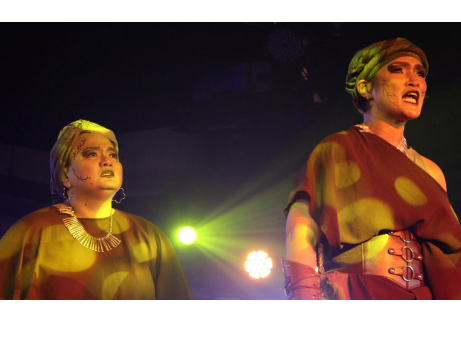
On that note, I’d like to commend Katski Flores, playing Yaya, Miren Alvarez-Fabrego, playing Medea, and Joseph Dela Cruz, playing Egeo, for sticking out for me and many of the audience members. Their sharp, emotionally raw, yet natural performance made their characters come alive, like they were really there in the flesh. I especially loved how Miren Alvarez-Fabrego poured so much villainous energy into Medea—her performance showed just how evil and apathetic the character is.
Attire-wise, I—and many others in the audience—loved the characters’ costumes and makeup. Contrary to my expectation, their costumes weren’t the stereotypical Greek attire. Rather, they reflected a more Mediterranean style, with poppy colors and a variety of jewelry from the region. As for the makeup, it was simply exceptional. It effectively highlighted the ages and personalities of each character, and, most importantly, looked great. Besides aesthetics, makeup and attire were also practical, featuring few elements—perhaps to be resourceful.
As for stage design, it could be improved. I commend it for being simple and resourceful, only using six elements—four at the back of the stage and two at the center of the stage. However, I fear this design may leave audiences unfamiliar with the play confused about the setting. The setting is not completely obvious at first sight, and requires some 5 minutes to understand it. But, this shouldn’t hinder anyone from watching the play. For the entire duration of Ang Medea, the setting does not change, so understanding it once is all that’s needed.
Technicals (sound design & lighting), sound design specifically, could also use a few improvements. As an audience member also pointed out, it was hard to tell the difference between a few sound effects, such as thunder and rain. However, besides that small oversight, the sound design and lighting added to the overall enjoyment of watching the performance. I especially loved how expressive the lighting was—it was erratic and tense, which really uplifted the scenes near the end of the play.
With that being said, Teatro Meron’s Ang Medea was a thrilling and entertaining performance. It has its fair share of flaws, especially in stage design and technicals, but the play makes up for it in the characters’ strong delivery and amazing attire. Ang Medea isn’t perfect, but its strong portrayal keeps the audience drawn to the performance, despite some technical and stage design oversights.
Unexpectedly, despite not being a theatre fan, I found myself drawn to the story of Medea—analyzing its characters and themes, and connecting them to what I saw in the performance. So, theatre fan or not, if you’re a fan of emotion-filled storytelling with a riveting yet simple plot, I’d totally recommend Ang Medea. It is, in the words of director and founder of Teatro Meron, Ron Capinding, a “celebration of the Filipino language.” Just don’t forget to bring your Filipino dictionary—it will be handy!
Catch Teatro Meron’s Ang Medea at the Mind Museum Special Exhibition Hall, Bonifacio Global
City (BGC) on these dates:
● November 13, 14, 20, 21, 27, and 28 at 8:00 PM for evening shows
● November 15 and 22 at 3:00 PM and 8:00 PM for matinee and evening shows
● November 16 and 23 at 3:00 PM and 7:00 PM for matinee and evening shows
Tickets are available to buy at https://tinyurl.com/angmedea for P2,000.