
WORLD DISCO SOUP: Enderun’s Love Letter to Sustainable Food Management
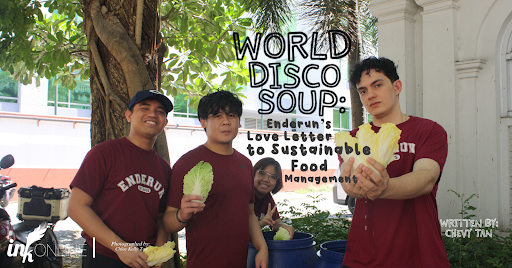
If you’ve been keeping opening your Enderun inbox, you probably spotted the Office of Student Life and Lux Lucis dropping invites for volunteers to join something called “World Disco Soup.” And if you’re anything like me—equal parts curious and nosy—that name definitely made you do a double-take. What even is a World Disco Soup? What goes down at one? And why does it sound like a global phenomenon when it mostly seems to make waves on campus?
These questions followed me as I joined a group of volunteers on a Saturday morning. Skipping on my rest day, I half-expected to find students standing around, bored and unsure of what to do. Instead, I walked into a lively scene: volunteers chatting, laughing, packing boxes, and chopping piles of vegetables, all to the beat of early 2000s pop songs. It all had an effortless rhythm—as if everyone instinctively knew their role. Some managed registration; others sliced carrots and lettuce with assembly-line precision. A few brave souls washed the produce in the sun-drenched courtyard under the heavy heat.
With enough brains to leave this captivating tempo alone, I eventually found the person orchestrating it all: Lux Lucis‘ Moderator, Sir John Cesar “CJ” Echiverri. Between assigning tasks and warmly greeting volunteers, he took a moment to share the story behind World Disco Soup—a tradition that extends far beyond Enderun’s walls.
As it turns out, World Disco Soup began as a creative protest against the global food crisis and food waste in Berlin, Germany. Organized by the Slow Food Youth Network, it was aptly dubbed “a protest soup.” The movement eventually made its way to Enderun Colleges in 2018 under the guidance of Ms. Bel Castro, Dean of the College of Hospitality Management, who inspired students to participate in this meaningful push for sustainability. Since then, Titans of all ages have gathered on campus every April to keep the tradition alive.
This 2025, Ms. Bel turns over the torch to Sir CJ for planning. As he notes, “Our (Lux Lucis) main goal is to gather donated vegetables from farms and raise awareness to consumers on the availability of produce.” He continues, “Our students must be taught to be aware that produce, despite its imperfections, can still be used to make hearty and fulfilling meals. Essentially, we at Lux decided we wanted to be a part of the sustainable advocacy, and beyond that, it’s our way of giving back to the community that’s supported the scholarship office.”
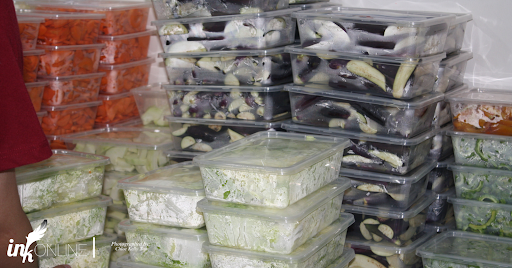
While The International World Disco Soup is scheduled on April 26, Sir CJ made the thoughtful decision to hold Enderun’s event a day earlier, ensuring volunteers had enough time and space to fully embrace the experience. Additionally, this year’s WDS yielded 272 pre-cut vegetables to be packaged and sent to neighboring Barangay Pinagsama for distribution amongst families.
The event also received the vital support of alumna Danielle Tensuan and Kass Damuy, who assisted Lux in garnering donations. Sir CJ credits them as full-fledged mentors who make resources and circularity more prominent on Enderun grounds. And, of course, the unconditional support of the Senior High School Principal––Ms. Cherry Lim beckoned SHS Titans to be a massive part of the World Disco Soup while providing the necessary space for the event. However, the endeavors don’t end there; what truly sets this year’s WDS apart is its joint effort to unite organizations and their members in an altruistic yet crucial project.
Enderun Care, more lovingly known as ECARE, was a strong contributor to the 2025 WDS. It brought in Earthventure Inc.’s Founder, Ms. Catherina Papio, to ensure the proper decomposition of the leftover vegetable skin and adequately handle food waste.
As ECARE Moderator, Ms. Mhyles Oliva, explained, “ECARE truly wants to make food waste more circular. Through Earthventure’s Bokashi––a method that converts food waste into nutrient-rich soil through anaerobic fermentation––we can ensure that the vegetable scraps from World Disco Soup will decompose accordingly and avoid the spread of greenhouse gases like methane and nitrous oxide.”
Although it was ECARE’s first time to participate in World Disco Soup, its members actively engaged in the composting activities. Their commitment aligned with the long-term vision of integrating composting as a standard practice within Enderun’s culinary and kitchen operations. As Ms. Mhyles states, “Composting through Bokashi may be the answer to achieving zero food waste at Enderun. Data collected by my students in International Sustainability classes revealed that food waste is the largest contributor to the campus’s overall waste. Given this finding, the World Disco Soup provided the impeccable opportunity for ECARE to do a pilot testing on Bokashi Composting.”
And for the finale, Ms. Mhyles and ECARE also plan to send out the natural fertilizers to farms in order to combat soil degradation. The Bokashi compost made from WDS is set to arrive at Laguna Farm, Caliyara and Batangas’ Kayumanggi Farm respectively.
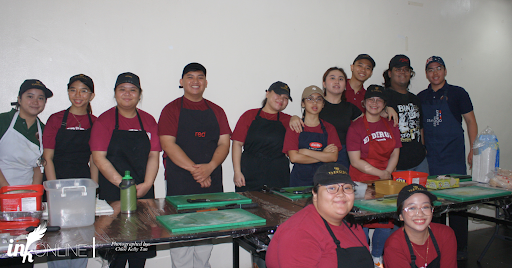
Perhaps the staunch advocacies of Ms. Mhyles and Sir CJ are why I found volunteers happy and engaged in the mission of food management. But as we know, moderators can go only as far as encouraging. Our Titans are innate champions of sustainability and are willing to take advantage of the space and support in making green practices more
viable. I found success in the World Disco Soup through everyone’s willingness to work together as a team and the individual drive to make events possible. As Ms. Mhyles concludes, “Whenever we plan for community initiatives, we want everyone to be involved. Personal participation is what makes sustainability alive in Enderun. We inculcate green initiatives beyond the paper and into reality through our students’ passions.“